
You are on this branch: Headroom home / Price method
Price method: the archived payment formula, run backwards
Every number on this site comes from four inputs: a listing price, Pandagoo's archived payment formula, a dated exchange rate and dated freight quotes. This page shows each one and where it came from.
Stress-test the amount left for goods
Illustrative US$100 cap: assume US$10 remains reserved for unpriced extras, and each payment uses a hypothetical US$0.50 fixed charge plus 5%. Using the archived formula, compare two freight assumptions.
| Freight before handling | Freight payment | Goods value left before its handling |
|---|---|---|
| US$25 | (25 + 0.50) ÷ 0.95 = US$26.84 | (100 − 10 − 26.84) × 0.95 − 0.50 = US$59.50 |
| US$40 | (40 + 0.50) ÷ 0.95 = US$42.63 | (100 − 10 − 42.63) × 0.95 − 0.50 = US$44.50 |
The US$15 freight increase removes US$15 from the goods allowance under these assumptions. Domestic delivery still comes out of that allowance. Enter your own figures in the Headroom finder and use QC and shipping checks before treating a basket as affordable.
The formula as the checkout page printed it
Pandagoo's payment screen, as archived on March 8, 2026, carried a line that explained how the amount to pay was built. It is the one piece of fee arithmetic that survived:
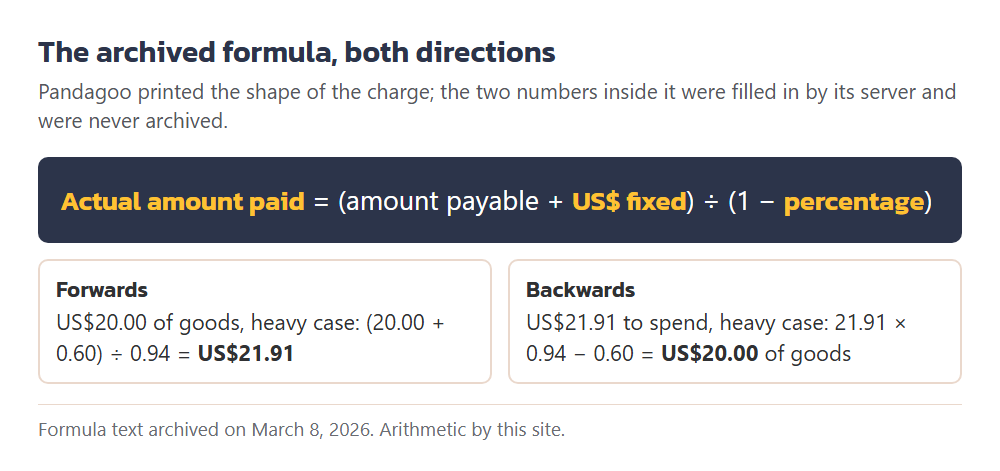
“Actual amount paid = (Amount payable for goods or parcels + US$ Fixed commission) / (1 - Percentage commission)”
Three things follow from it. The charge applies to goods and to parcels, so an order pays it twice, once at each checkout. It has a fixed part in dollars, so a small payment carries a bigger share. And it divides rather than multiplies, so a 6 per cent percentage costs a little more than 6 per cent of the goods: on US$100 it adds US$6.38, not US$6.00.
The same screen had labels for Handling Fee, Fixed Handling Fee and Actual Payable. Their values came from Pandagoo's server when the page loaded and were never saved by the archive.
Turning the formula around
Going forwards, you know the goods and want the payment. Going backwards, you know the payment you can afford and want the goods. Rearranged, the archived formula gives goods = payment × (1 − percentage) − fixed part.
A whole order has two payments, so the finder solves it in this order:
- Freight for the parcel weight, from the quotes below.
- Second payment = (freight + fixed) ÷ (1 − percentage).
- First payment you can afford = ceiling − second payment.
- Goods money = first payment × (1 − percentage) − fixed.
- Goods money in yuan = goods money ÷ 0.14992.
- Sticker headroom = (yuan − seller postage) ÷ pieces.
The floors use the same formula in the forwards direction on the smallest order of each listing, without freight.
Why the handling charge is an assumption here
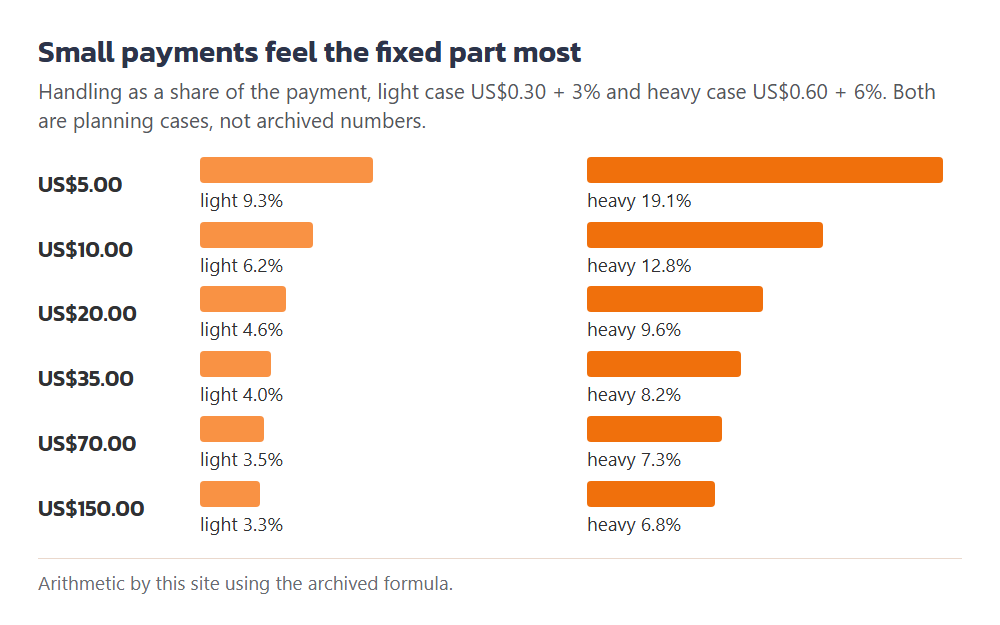
We do not know Pandagoo's fixed part or percentage. The archive has the formula and the labels, and nowhere a number. So the site carries two planning cases and lets you type a third:
- Light, US$0.30 + 3 per cent. A modest case, for when you expect the fee to be mild.
- Heavy, US$0.60 + 6 per cent. Deliberately pessimistic, so that a plan built on it still holds if the real fee is high.
These are not Pandagoo's numbers and the site never presents them as such. The floors are built so that the heavy case and the no-charge case put a listing on the same floor; that is the point of carrying both.
One more thing the chart shows: with a fixed part, splitting goods across several small checkouts costs more than paying once. Three US$5 payments at the heavy case pay US$2.87 in handling; one US$15 payment pays US$1.60.
Yuan into dollars: the reference rate we used
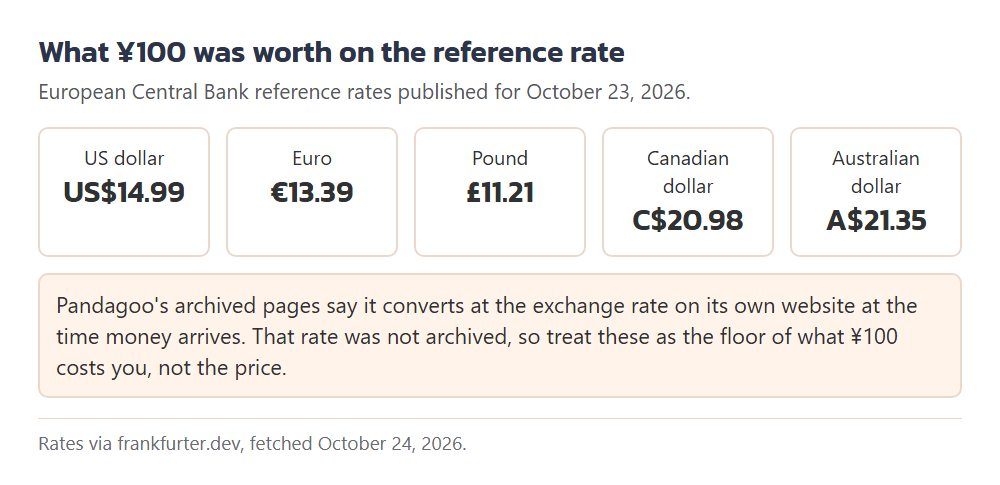
1688 prices are in yuan. To turn them into dollars we used the European Central Bank reference rate published for October 23, 2026: one US dollar to 6.6702 yuan, so one yuan is US$0.14992. It is a midpoint between banks, not a rate any shopper gets.
Pandagoo's archived pages describe two money paths. A card or wallet payment is charged in your currency at checkout. A bank transfer is converted to yuan when it arrives, at the exchange rate shown on Pandagoo's own website at that time, after which it sits in your balance in yuan; the receiving bank also took HKD 65 a transfer, and top-ups ran from ¥10 to ¥5,000 a time. The archived rate itself was never saved. Expect to pay somewhat more for each yuan than the reference rate says; how much more decides whether a find near the top of a floor still fits.
Freight figures borrowed from a second agent
Pandagoo's archived pages describe how freight was charged, never what. The line table came from its server and is gone. To give the finder something real, we read another agent's public freight estimator on October 24, 2026: ten destinations, five weights from 500 g to 5 kg, general goods, our own box sizes for each weight.
For each case we kept the cheapest line that accepted the parcel and the middle price of all lines that did. The cheapest line is often a postal service with a narrow list of accepted goods. The middle figure is the safer one to plan on, and the finder offers both.
On Pandagoo, according to the archive, freight was paid after the parcel was built: an automatic quote paid up front and settled after weighing, or a manual quote within 8 hours for parcels handed in from nine to four, Beijing time. Payment was due within 72 hours of submitting the parcel. And when the real cost came in lower:
“4. If the actual shipping cost of your package is less than the shipping cost you paid, we will refund the difference to your account balance when sending your package.”
That refund goes to your balance, not your card, which is worth knowing when you set a ceiling: money left in a balance is only useful if you order again.
| Destination | At 500 g | At 1 kg | At 2 kg | At 3 kg | At 5 kg |
|---|---|---|---|---|---|
| Ireland | US$26.01 | US$35.50 | US$54.47 | US$71.14 | US$104.46 |
| United Kingdom | US$13.84 | US$21.40 | US$36.53 | US$51.65 | US$81.90 |
| Netherlands | US$23.91 | US$30.89 | US$45.30 | US$59.56 | US$88.08 |
| Germany | US$17.95 | US$26.30 | US$42.99 | US$59.34 | US$88.57 |
| France | US$24.35 | US$32.17 | US$47.29 | US$62.42 | US$103.96 |
| Italy | US$24.32 | US$32.11 | US$47.69 | US$63.27 | US$94.43 |
| Spain | US$21.91 | US$29.60 | US$44.99 | US$60.37 | US$96.89 |
| Canada | US$21.78 | US$32.42 | US$53.70 | US$74.98 | US$117.54 |
| United States | US$22.55 | US$36.01 | US$62.93 | US$89.85 | US$143.94 |
| Australia | US$16.74 | US$25.09 | US$39.63 | US$54.16 | US$83.20 |
Our box sizes were 28 × 20 × 6 cm for half a kilo, 32 × 24 × 9 for one kilo, 38 × 28 × 13 for two, 42 × 32 × 15 for three and 48 × 36 × 20 for five. Bigger boxes for the same weight can cost more; see size weight on the parcels page.
The seven gaps between a sticker and your ceiling
Here is the full cost breakdown the site works with, gap by gap. Pandagoo's archive promised no purchasing service fee, so there is no separate service fee line on goods; the money that matters sits in these seven places instead.
- Option gap. The big price at the top tends to be the cheapest option on the page. The shell jacket here reads ¥79 and goes to ¥225 with the down liner.
- Batch gap. The first price tier starts at a quantity. Ten card readers, three backpacks, five hoodies.
- Postage gap. What the seller charges per order to send your goods to the warehouse inside China. ¥0 to ¥10 on our finds.
- Handling gap, goods. The archived formula on the first payment.
- Rate gap. Whatever your card, wallet or the agent adds to the reference rate.
- Freight gap. The second payment, with its own handling. On small ceilings, the biggest line of all.
- Exit gap. If you send something back without a quality problem, the archived returns text has you pay the domestic postage. Cancelling a parcel after paying its freight cost 20 yuan, according to the archived parcel text.
Put the seven gaps to work in the Headroom finder, or see the option and batch gaps on real listings on the listings page.