
You are on this branch: Headroom home / Photos, parcels and freight
Arrival photos, parcels and freight under a ceiling
The part of an order after the goods checkout: what the warehouse photos are for, how a parcel is weighed and priced, and the declared value. Each section ends with what it does to a fixed budget.
Quality check photos: the last cheap exit
QC photos are what the warehouse shoots as soon as your item is checked in. Pandagoo's archived pages promised five shots per item as standard and three of the packed parcel, with extra shots on request at no charge. They are not an inspection report. They are your only look at the thing before it leaves China.
That is what makes them valuable on a budget. While the item sits in the warehouse, a wrong colour or a missing piece costs a domestic return at most. After the parcel ships, the same mistake costs international freight both ways, or you keep it. The archived returns screen took applications within 5 days of the item being signed for, so read them on the day they show up.
Ask for an extra photo whenever the default five do not show the one detail that decides the purchase: the inside label of the jeans grade you paid for, the size stamp on a boot, the scent printed on a perfume box.
Checking QC photos in order of what a miss would cost
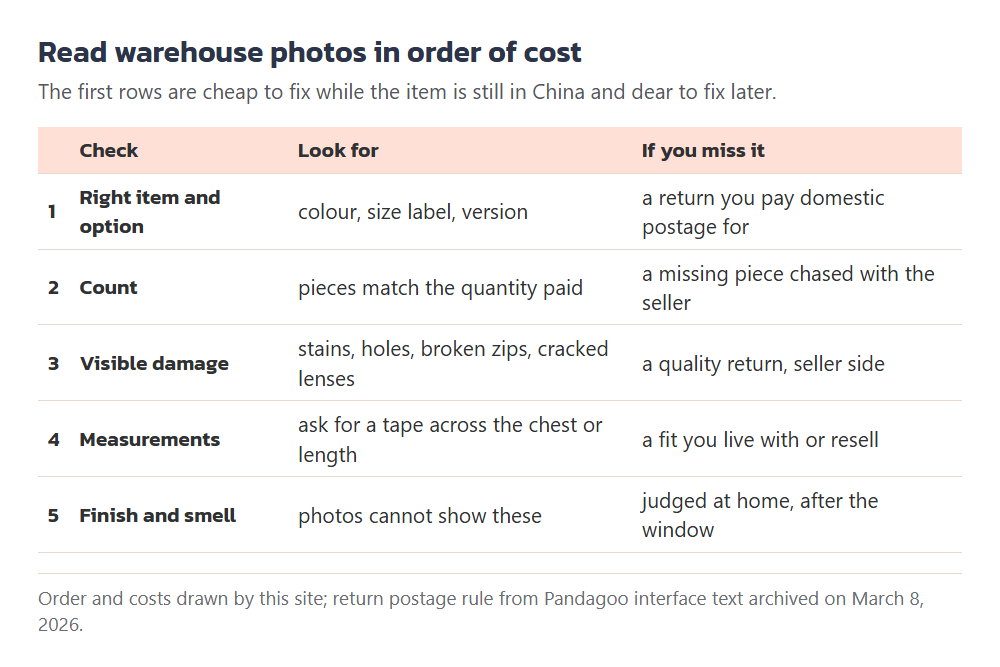
Here is how to judge a QC set in a few minutes. Go through them in this order, because the first checks are the ones that are cheap to fix now and dear to fix later.
- Right item, right option. Match the photo with the option you paid for. On our finds, that means the cotton or the fleece zip hoodie, straight or cuffed joggers, the shell alone or the shell with a liner.
- Count. Ten card readers should be ten. Three backpacks should be three. The batch gap only pays off if the batch arrives.
- Visible damage. Stains, holes, a zip that will not close, a cracked lens. These are quality problems, and the archived text only put return postage on you when there was no quality problem.
- Measurements. Ask for a tape across the chest of a coat or along the leg of the raw denim. Size charts on 1688 are often written by body weight in jin, and one of our listings translated jin as pounds.
- Finish and smell. Photos cannot tell you these. Accept that part of the risk, or buy where it matters least.
The freight landing and its second checkout
Shipping is the second payment, and the one most budgets underestimate. Pandagoo's archived pages describe two ways to get a price. An automatic quote uses item weights plus an estimated packing weight; you pay it up front and the difference is refunded or charged after packing. A manual quote has the warehouse measure the real parcel first.
Which line you choose decides most of the bill. In the quotes behind our finder, the cheapest one-kilo line to the United Kingdom was US$21.40 with a 7 to 14 day window; to the United States, US$36.01 with 15 to 20 days. The middle of the quoted lines was between a quarter and a third dearer in both. Faster lines and lines that accept special goods sit above the middle.
Special goods narrow the choice. The archived freight estimator had tick boxes for glasses, power banks, goods with a battery inside, small bottles of cosmetics and electronics, and its list of forbidden goods started with perfume. On our floors, that touches the speaker, the projector, the card reader and the gardenia scent: put them in a parcel with ordinary clothes and the whole parcel may need a dearer line.
Volumetric weight on a budget parcel
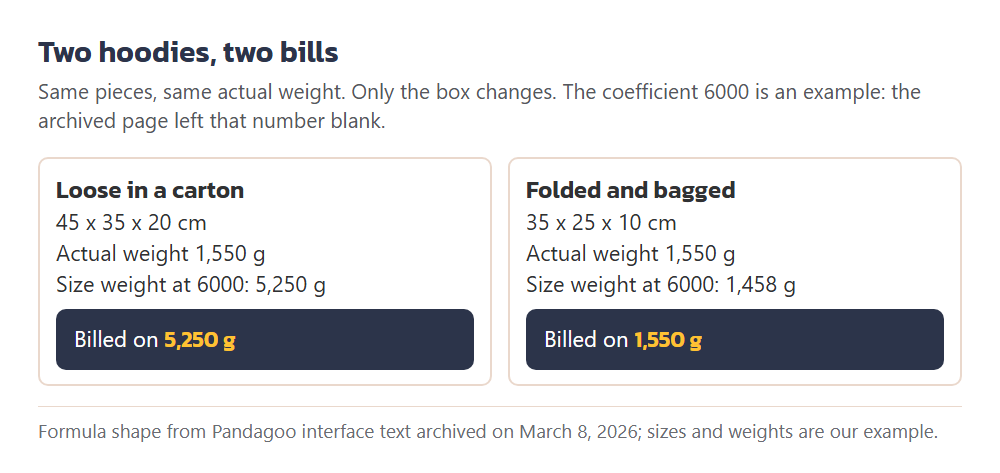
Lines charge on whichever is greater: the scale weight or a size weight worked out from the box. Pandagoo's archived text worked out the size weight by multiplying the three box edges together, dividing by a volume coefficient and multiplying by 1,000 for grams. The coefficient was a server value and is not in the archive; 6000 and 5000 are common elsewhere.
In the example, two fleece hoodies weigh 1,550 g with packing. Loose in a 45 × 35 × 20 cm carton they bill as 5,250 g. Folded into a bag of 35 × 25 × 10 cm, the size weight drops to 1,458 g and the scale weight wins. Same clothes, a bill more than three times smaller.
For bulky pieces, the rehearsal package described in the archive is the honest way to know: the warehouse packs the parcel and shows the true weight and dimensions ahead of the freight payment.
Customs value and the declared figure
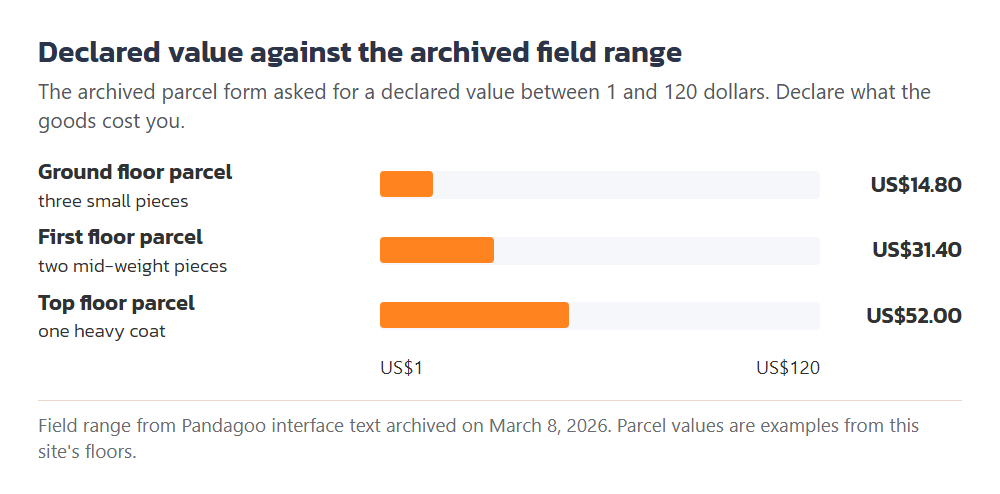
The archived parcel form asked for a declared value in dollars, within a range of 1 to 120. It is the figure customs in your country sees. Declare what you paid for the goods in that parcel. Duty and tax rules belong to your own country and change; this site does not try to summarise them, and nothing on it suggests declaring less than you paid.
For a budget, the useful point is the opposite one: if your country charges import tax on low-value parcels, that tax is an eighth gap the finder does not include. Leave room for it.
Next: listings, sellers and agents, or back to the Headroom finder.