
You are on this branch: Headroom home / Headroom finder
Headroom finder: the highest sticker price your ceiling allows
Give it the total you will spend and where the parcel goes. It returns the most each piece can cost on the listing, and lights up the floors that reaches.
Run the Headroom finder
Headroom finder, explained one box at a time
Here is how to use the tool if you have never priced an agent order before. Fill the boxes from the top; the defaults are a real case, two hoodies to Ireland on a US$60 ceiling, so you can press the button first and read the answer.
- All-in ceiling. The most you will spend, counting both payments. Not the goods budget: the whole thing.
- Parcel lands in. Ten countries. Each has dated quotes for 500 g, 1, 2, 3 and 5 kg; weights in between are read off a straight line.
- Pieces and what they are like. Pieces times the weight you pick, plus 150 g for carton and tape, gives the parcel weight. The weights are our planning figures. If you have a seller weight, choose "I know the weight".
- Seller postage. The listing shows it next to the price; it is per order, not per piece. Many 1688 sellers charge ¥3 to ¥10.
- Handling charge. Pandagoo's checkout used a fixed part plus a percentage on each payment, and the archive kept the formula without the numbers. Heavy is the default because a budget should survive the worst plausible case.
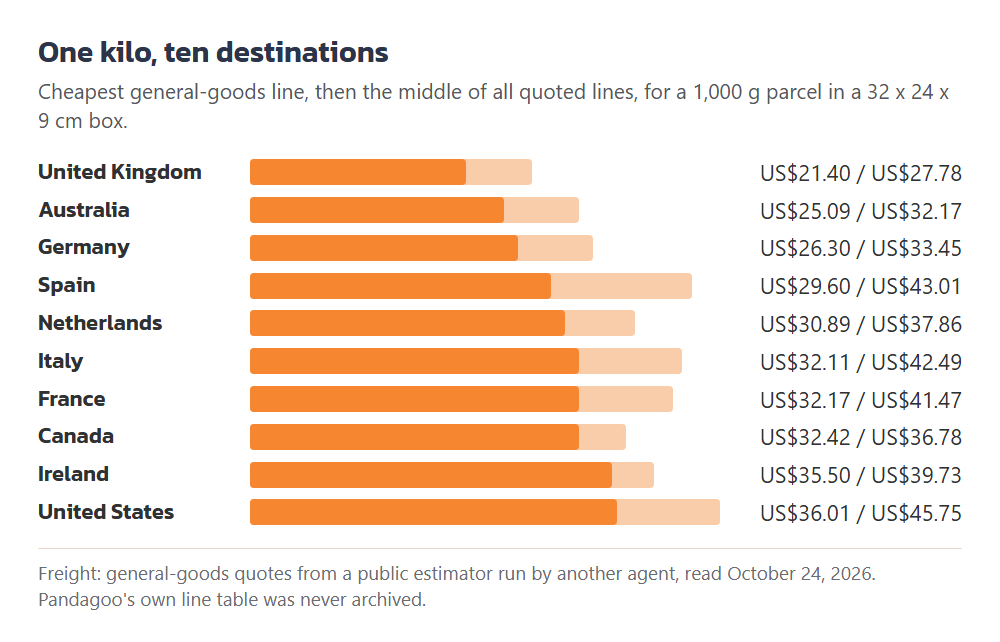
- Freight figure. The cheapest line is a floor price; some cheapest lines are slow or refuse certain goods. The middle of the quoted lines is a safer planning figure.
- Listing price. Optional. Type the sticker of something you are looking at and the finder counts how many of it fit.
Three ceilings worked through
All three use the heavy handling case and the cheapest quoted line.
- US$45.00, two tees to the United Kingdom. Parcel 610 g, freight US$15.50, freight checkout US$17.13 with handling. Goods money ¥170.74; minus ¥6.00 postage, divided by 2: ¥82.37 a piece. One piece at that price pays US$13.78 at checkout, which is the First floor.
- US$90.00, a hoodie and a pair of jeans to the Netherlands. Parcel 1,450 g, freight US$37.37, freight checkout US$40.40 with handling. Goods money ¥307.00; minus ¥10.00 postage, divided by 2: ¥148.50 a piece. One piece at that price pays US$24.32 at checkout, which is the Second floor.
- US$150.00, one pair of boots to the United States. Parcel 1,450 g, freight US$48.12, freight checkout US$51.83 with handling. Goods money ¥611.50; minus ¥6.00 postage, divided by 1: ¥605.50 a piece. One piece at that price pays US$97.21 at checkout, which is the above the top floor.
Read across the three and the pattern is plain: on a small ceiling, freight eats most of it; on a large one, the handling percentage starts to matter more than the fixed part.
When the finder says no
The finder refuses rather than guessing in four cases, and says why.
- A ceiling of zero or less. There is nothing to work back from.
- A ceiling below the freight. If the second payment alone is bigger than your ceiling, it tells you the smallest ceiling that leaves any goods money at all. Small ceilings to Ireland and the United States hit this first: half a kilo costs US$22 or more on the cheapest line.
- Seller postage that swallows the rest. When the goods money in yuan is smaller than the postage you typed.
- A parcel over 5 kg. We only have quotes up to 5,000 g. The finder tells you how many pieces fit in one parcel at that weight and suggests running the rest as a second parcel, which also pays its own fixed handling part.
Once you have a number, open the floor it reaches: Ground, First, Second or Top.